ABOUT
Biography
Junko Yoda (b. 1943, Tokushima, Japan) is a Japanese-born, New York–based artist whose practice spans painting, installation, and mixed media. A graduate of the renowned Musashino Art University, Yoda’s artistic direction was profoundly shaped in 1966 after encountering American Abstract Expressionism for the first time at The National Museum of Modern Art, Tokyo. The experience, particularly her exposure to Jackson Pollock’s painting Number 8, left a lasting impression that would influence her artistic approach.

Junko making The Hudson, 2006
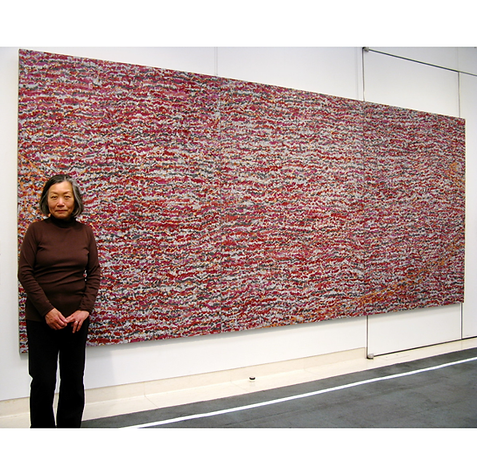
Junko in front of Untitled #L-11 (Susquehanna River), 1994
Junko relocated to New York in 1969, where she continues to live and work. Soon after arriving, she shifted from oil on canvas to acrylic and washi, traditional Japanese handmade paper, developing a distinctive visual language that bridges Eastern materials with Western abstraction.
Her early career gained momentum with her inclusion in the “New Talent Show” at Zabriskie Gallery in 1978, followed by her first solo exhibition, Painted Paper, in 1980. Her work has since been widely exhibited in both the United States and internationally, including solo exhibitions in New York and Paris.

River of Hiroshima, 2001
Throughout her career, Yoda has continuously evolved her practice, often drawing from personal experience, memory, and place.
In 2001, while working on River of Hiroshima for the Hiroshima City Museum of Contemporary Art, she witnessed the events of September 11 from her New York studio, an experience that deepened the emotional resonance of the work’s themes of life and love.
During the work on "River of Hiroshima," I saw the horrific destruction of the Twin Towers from the roof of my studio
Her later works expanded into installation and sculptural forms, notably with her series of handcrafted papier-mâché seashells, which led to the exhibition Waves. Critics, including Grace Glueck of The New York Times, have recognized her ability to transform delicate materials into powerful, immersive compositions.
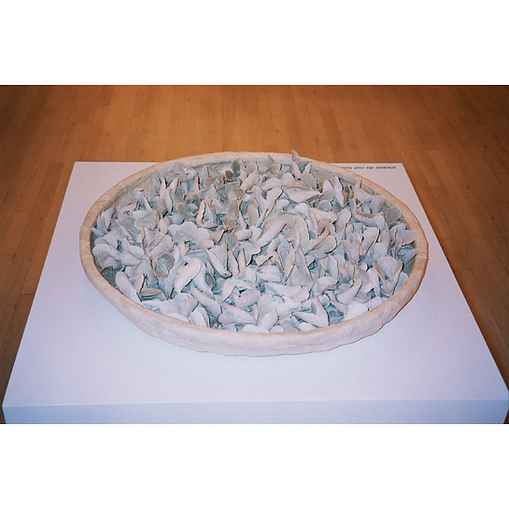
Waves #2, 2004

The Hudson, 2006
In 2005, she was awarded a grant from the Pollock-Krasner Foundation, enabling her to further explore large-scale works using washi from Tokushima where she was born. With this washi, she was able to make large-scale artwork, including The Yoshino River and The Hudson, reflecting her enduring connection between Japan and New York.
Recurring themes in Junko’s work include geography, memory, and the passage of time. Her Central Park series, inspired by historical maps and archival material, exemplifies her interest in layering history with personal narrative.
More recently, she has incorporated photography into her practice, documenting the evolving New York cityscape, including the iconic 56 Leonard Street building, known more commonly as Jenga Building by New York residents.
%232%2C%202021.png)
Tribeca Skyline (Jenga Building) #2, 2021

Poster for Every Day is Art Day: Fifty Years of the Yoda Family in New York
Junko’s work has also been exhibited in the context of her family’s artistic legacy, notably in Every Day is Art Day: Fifty Years of the Yoda Family in New York at Mitaka City Gallery of Art in 2019, as well as subsequent group exhibitions in New York.
The Yoda’s NYC studio home has also been featured in the New York Times in an article, A Family of Three in a SoHo Loft Without Walls
Selected Timeline
With a career spanning over five decades, Junko Yoda continues to explore the expressive possibilities of material and memory, creating works that are both deeply personal and universally resonant.
1943
Born in Tokushima Japan
1969
Moves to New York
1978
Group exhibition “New Talent Show,” Zabriskie Gallery, New York
1980
First solo exhibition, Painted Paper, Zabriskie Gallery, New York
1984–1985
Solo exhibition at Galerie Zabriskie, Paris
2001
Completes River of Hiroshima commissioned by Hiroshima City Museum of Contemporary Art
2004
Begins papier-mâché seashell works, leading to installation-based practice
2005
Receives Pollock-Krasner Foundation grant; creates The Yoshino River and The Hudson
2007–2008
Group exhibition Making A Home: Japanese Contemporary Artists in New York, Japan Society curated by Eric C. Shiner
2008
Presents Shadows of the Clouds, Zabriskie Gallery
2010
Solo exhibition Central Park, Zabriskie Gallery
2019
Every Day is Art Day: Fifty Years of the Yoda Family in New York, Mitaka City Gallery of Art
2022
Family exhibition at Court Tree Collective, Brooklyn
2023
The 3 YODAS, Gallery MC, New York
2024
Group exhibition Post No Bills, NowHere Gallery, SoHo
2026
Group exhibition Sakura: A Season of Becoming, Romanian Cultural Institute
Education
1962–66 Musashino Art University, Tokyo (BFA)
1967 Musashino Art University, Special Course in Painting
Selected Solo Exhibitions
2014 Gallery MC, New York
2010 Zabriskie Gallery, New York
2008 Zabriskie Gallery, New York
2006 Zabriskie Gallery, New York
2004 Zabriskie Gallery, New York
1984–85 Galerie Zabriskie, Paris
1980 Zabriskie Gallery, New York
Selected Group Exhibitions
2024 NowHere Gallery, New York
2023 Gallery MC, New York
2022 Court Tree Collective, Brooklyn
2019 Mitaka City Gallery of Art, Tokyo
2007 Japan Society, New York
1988 San Diego Museum of Art
1978 Zabriskie Gallery, New York
Collections
Hiroshima City Museum of Contemporary Art
Ohara Museum of Art
Takamatsu City Museum of Art
Tokushima Modern Art Museum
Mitaka City Gallery of Art
Tottori Prefectural Museum of Art
Essl Collection, Vienna
Grants
2005 Pollock-Krasner Foundation Grant 1991 Holbein Scholarship Award